

Views: 0 Author: Site Editor Publish Time: 2026-04-09 Origin: Site


Chemical waste in farming is a practical issue that affects cost, crop performance, environmental management, and spraying efficiency at the same time. In our view, the question is not simply how much chemical is loaded into the tank, but how much of it actually reaches the intended target and performs its job effectively. When too much spray misses the crop, drifts away, evaporates, runs off, or is applied unevenly, waste begins long before anyone notices the final field result.
From our perspective as a company involved in agricultural spraying equipment, a sprayer can absolutely help reduce chemical waste in farming, but only when it is designed and used with precision in mind. A sprayer is not just a delivery machine. It is a control system for placement, droplet behavior, coverage, and application consistency. The better that system performs, the less unnecessary loss occurs during spraying.
Many people think chemical waste in farming only comes from overuse, but that is not the whole issue. Even when the correct application rate is used, waste can still happen if the spray misses the target, drifts away, or does not deposit properly on the crop surface.
In our view, a good sprayer cannot prevent every form of waste, since weather, crop conditions, and field operation also matter. However, it can reduce avoidable loss by improving spray control, coverage, and application accuracy.
Drift is one of the most familiar causes of spray waste. When droplets move away from the intended area because of wind, temperature, air movement, or droplet size, the product is no longer serving its purpose. This means the farm pays for chemical that does not contribute to crop protection or crop nutrition.
In our experience, drift control is not only about avoiding visible mistakes. It is also about improving the percentage of spray that stays useful. A sprayer that supports better nozzle selection, stable pressure, and more suitable droplet formation can reduce the likelihood of drift-related loss.
Waste also happens when application is inconsistent across the field. Some areas may receive too much product while others receive too little. In that case, one part of the field experiences overspray, while another part may need re-treatment later. Both situations increase waste.
This is why spray uniformity matters so much. When a sprayer distributes liquid more evenly, the farm gets closer to the intended dose across the working width. That helps reduce both under-application and over-application.
Not every droplet that reaches the crop remains there effectively. If the droplet size is not appropriate, or if the spray hits the plant surface with poor retention characteristics, liquid may run off instead of staying on the target. This can happen especially when too much volume is applied, when leaf surfaces are difficult to wet, or when droplet behavior is not suited to the crop condition.
We see this as another hidden form of chemical waste. The tank may empty as planned, but the effective deposition may still be lower than expected.
Sometimes chemical waste is indirect. A poor spray application can reduce treatment effectiveness, which may then lead to another pass through the field sooner than planned. In such cases, the waste is not only the product lost during the first application, but also the added labor, time, fuel, and chemical associated with correction.
For this reason, we believe a sprayer reduces waste not only by controlling liquid better in one moment, but also by supporting more reliable performance over the full spraying cycle.
At the most basic level, a sprayer reduces chemical waste when it helps place the right amount of liquid in the right location under the right conditions. This sounds simple, but in real farming it depends on several linked functions.
First, the sprayer must maintain stable output. If the flow varies too much, the application rate becomes less predictable. Second, the spraying system must support appropriate nozzle performance, because nozzles directly influence droplet size, spray angle, and target coverage. Third, the machine should operate in a way that supports consistent boom performance, field coverage, and pressure control.
We often describe this as reducing unnecessary movement of the chemical. The more accurately the sprayer controls where the liquid goes and how it behaves after leaving the nozzle, the less waste the farming operation experiences.
Some people hear the phrase precision spraying and immediately think of expensive technology or overly complicated systems. We do not see it that way. In our view, precision begins with practical control: stable spraying pressure, proper nozzle matching, suitable boom configuration, consistent travel speed, and equipment that helps the operator avoid unnecessary loss.
A sprayer does not need to rely only on advanced digital features to reduce waste. Even fundamental design quality matters. A machine that applies more consistently, operates more reliably, and supports better spray behavior can already reduce chemical loss compared with a system that is harder to control in field conditions.
That said, the movement toward more precise agriculture has made waste reduction even more achievable. As spraying equipment improves, farmers can make decisions with greater confidence and less guesswork.
Nozzle selection is one of the clearest examples of how a sprayer can influence waste reduction. Different nozzles produce different droplet sizes and spray patterns. These differences affect drift, coverage, deposition, and overall application efficiency.
A nozzle that produces droplets that are too fine for the field conditions may increase drift. A nozzle that produces droplets that are too coarse for the application objective may reduce coverage. A nozzle that does not match the target or crop structure may deliver poor distribution. In each case, some portion of the product becomes less useful.
Because of this, we do not separate sprayer performance from nozzle choice. The sprayer provides the working platform, but the nozzle determines how the liquid exits the system. Waste reduction depends on both.
A well-designed sprayer should support practical nozzle selection for different jobs. Herbicide applications, fungicide applications, insecticide work, and foliar nutrition may each require different droplet behavior. If the sprayer allows flexible and reliable nozzle use, it becomes easier to reduce waste across multiple spraying scenarios.
Even the right nozzle can perform poorly if pressure is unstable or outside the intended operating range. Pressure affects droplet formation and flow rate, which means it also affects waste potential. This is one reason why pressure stability is more than a technical specification. It is a factor in chemical efficiency.
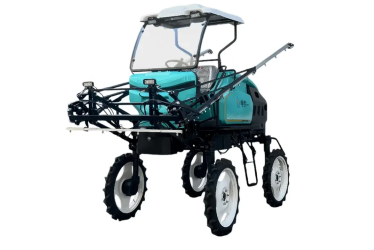
There is a common assumption that reducing chemical waste simply means spraying less. In some cases, that may be true. But in many practical situations, better spraying does not mean less product by default. It means more effective use of the product already being applied.
When coverage is more even, the chemical can perform more consistently across the field. This reduces the likelihood of weak treatment zones, missed targets, and unnecessary repeat applications. In that sense, better coverage supports lower waste even if the initial spray rate remains within the normal agronomic recommendation.
We believe this distinction is important. Waste reduction is not just about lowering volume. It is about increasing useful deposition.
Sprayer Function | How It Helps Reduce Waste | Main Risk When Performance Is Poor |
Stable pressure control | Supports consistent droplet formation and application rate | Uneven output, drift increase, poor coverage |
Suitable nozzle setup | Matches droplet size and pattern to the application need | Off-target loss, overspray, weak deposition |
Uniform boom spraying | Improves even distribution across the field | Overlap problems, untreated areas, rate inconsistency |
Better drift management | Keeps more spray on the intended target | Environmental loss and reduced application value |
Accurate field coverage | Reduces skipped zones and excessive overlap | Wasted chemical and uneven treatment results |
Reliable machine operation | Helps maintain repeatable spray performance | More correction spraying and lower efficiency |
A sprayer may reduce chemical waste, but only if it is used appropriately for the actual field task. We often stress that there is no single spraying setup that is ideal for every crop, weather condition, and treatment objective.
Open-field cereals, dense vegetable crops, orchards, and row crops all present different target structures. Some require deeper penetration, while others require broader surface coverage. If the spraying system is not matched to the crop environment, waste becomes more likely because the chemical is not being distributed in the most useful way.
Herbicides, fungicides, insecticides, and foliar fertilizers do not always require the same spray characteristics. Some rely heavily on coverage. Others may place stronger emphasis on drift control or placement precision. When the sprayer supports better adaptation to these differences, waste reduction becomes more realistic.
Wind, temperature, humidity, boom height, and travel speed all influence how the spray behaves after leaving the nozzle. A sprayer helps reduce waste when it allows more controlled operation under real field conditions. But it is also important for the operator to adjust decisions according to the environment rather than relying only on fixed settings.
So, can a sprayer reduce chemical waste in farming? In our view, yes, it can. It does so by improving placement accuracy, supporting better droplet control, reducing drift, helping maintain more uniform coverage, and making chemical application more efficient in real field conditions. Waste reduction is not only about using less product. It is about using product better.
When a sprayer is selected and operated with precision, it can help the farm reduce avoidable loss, improve treatment consistency, and make better use of every application. For readers who would like to know more about agricultural spraying equipment, spray efficiency, and practical approaches to reducing chemical waste in farming, we welcome you to learn more from Shandong Yuhe Intelligent Agricultural Equipment Co., Ltd.
Q: Can a sprayer really reduce chemical waste in farming?
A: Yes. A well-designed sprayer can reduce chemical waste by improving spray accuracy, reducing drift, and supporting more even application.
Q: What causes chemical waste during agricultural spraying?
A: Common causes include spray drift, uneven coverage, runoff, poor nozzle choice, and repeated applications caused by weak initial performance.
Q: How does nozzle selection affect chemical efficiency?
A: Nozzle selection influences droplet size, spray pattern, coverage, and drift control, all of which affect how much chemical reaches the target effectively.
Q: What should farms look for in a sprayer to lower spray waste?
A: Important factors include stable pressure, suitable nozzle compatibility, uniform spraying performance, reliable operation, and better control in varying field conditions.
