

Views: 0 Author: Site Editor Publish Time: 2026-03-27 Origin: Site


Agriculture has always been at the heart of human civilization, and the efficiency of farming equipment can significantly impact crop yield and farm productivity. Among the most important tools for modern agriculture are sprayers. These machines allow farmers to apply fertilizers, herbicides, pesticides, and water to crops more effectively and efficiently. Today, there is a diverse range of agricultural sprayers designed to meet the varying needs of farms worldwide. At Shandong Yuhe Intelligent Agricultural Equipment Co., Ltd., we are proud to offer solutions that meet modern agricultural demands with precision and reliability.
Agricultural sprayers are devices that distribute liquid substances over crops, soil, or fields. Their main purpose is to ensure uniform application of chemicals and nutrients, which can prevent crop diseases, control pests, and enhance plant growth. While traditional methods like manual spraying with hand pumps exist, modern sprayers are designed to cover larger areas efficiently, saving time, labor, and resources.
The types of agricultural sprayers vary based on operation methods, capacity, target crops, and terrain adaptability. Selecting the right sprayer requires understanding the specific farm requirements, the type of crops, and the scale of operations.
Backpack sprayers are lightweight, portable units designed for small farms, gardens, or greenhouses. They allow the operator to carry the tank on their back, making them ideal for areas with limited access or uneven terrain.
Advantages:
Portable and easy to maneuver
Affordable and low maintenance
Ideal for small-scale farms or precision spraying
Applications:
Backpack sprayers are commonly used in horticulture, vegetable gardens, and small orchards. They are perfect for spot treatments of weeds or pests, and their portability ensures farmers can reach difficult areas without difficulty.
Handheld sprayers are even smaller than backpack models and are usually operated by hand pumps. These sprayers are suitable for precise application in very small plots or individual plants.
Advantages:
Low cost
Easy to use for small tasks
Precise application
Applications:
Handheld sprayers are most commonly used for home gardens, indoor plants, or greenhouses, where fine control over the spray area is essential.
Boom sprayers are widely used for medium to large-scale farming. They feature a horizontal boom with multiple nozzles that spray chemicals uniformly across a wide swath of crops. Boom sprayers can be tractor-mounted, trailed, or self-propelled.
Advantages:
Covers large areas efficiently
Uniform distribution of chemicals
Can be adapted to different nozzle types for various crop heights
Applications:
Boom sprayers are ideal for row crops such as wheat, corn, soybeans, and rice. The adjustable boom height allows them to spray tall crops or low-lying plants effectively.
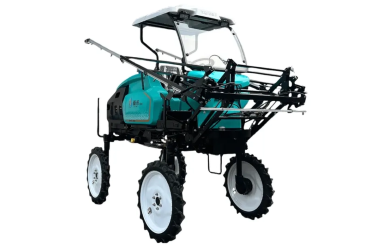
Airblast sprayers use a powerful fan to create an air stream that carries the spray droplets deep into the canopy of fruit trees or dense crops. This ensures that both the upper and lower surfaces of leaves receive adequate treatment.
Advantages:
Excellent for tree crops and vineyards
Reduces chemical waste
Efficient coverage of dense foliage
Applications:
Airblast sprayers are commonly used for orchards, citrus groves, and vineyards. They are highly effective in applying fungicides, insecticides, and foliar fertilizers.
Mist blowers generate a fine mist of liquid that spreads over crops, providing uniform coverage even in hard-to-reach areas. They can be hand-held or backpack-mounted, often combining portability with powerful spray capabilities.
Advantages:
Fine droplet size ensures better coverage
Good for tall plants and shrubs
Reduces water and chemical usage
Applications:
Mist blowers are suitable for horticulture, orchards, and greenhouses. They are particularly useful for pest control in densely planted areas.
Tractor-mounted sprayers are powerful machines designed for large farms and commercial agricultural operations. They can carry large tanks and cover extensive areas in a single operation.
Advantages:
High efficiency for large fields
Can be equipped with adjustable booms for different crops
Reduced labor compared to manual spraying
Applications:
These sprayers are widely used for cereal crops, oilseeds, and industrial-scale vegetable farms. Tractor-mounted sprayers are ideal when uniform application over large acreage is required.
With the advancement of agricultural technology, drone sprayers have emerged as an innovative solution for precision farming. These aerial sprayers can reach areas that are difficult or unsafe for traditional machines.
Advantages:
Precise spraying with GPS guidance
Efficient in hilly or inaccessible areas
Reduces human labor and exposure to chemicals
Applications:
Drone sprayers are used in modern smart farming practices, especially for rice paddies, orchards, and steep terrains. They can perform quick spot treatments and integrate with data-driven crop management systems.
To make it easier for farmers to choose the right sprayer, we provide the following comparison table:
Sprayer Type | Capacity | Ideal For | Advantages | Limitations |
Backpack Sprayer | 15–25 liters | Small farms, gardens | Portable, low cost, easy to operate | Limited coverage, manual effort |
Handheld Sprayer | 1–5 liters | Home gardens, greenhouses | Precise, very affordable | Very small area coverage |
Boom Sprayer | 400–2000 liters | Medium-large farms | Efficient, uniform spray | Requires tractor or machinery |
Airblast Sprayer | 200–1000 liters | Orchards, vineyards | Deep canopy coverage, reduced chemical waste | Expensive, requires training |
Mist Blower | 10–30 liters | Horticulture, orchards | Fine mist, efficient coverage | Limited tank size |
Tractor-Mounted Sprayer | 1000–5000 liters | Large commercial fields | High capacity, time-saving | Expensive, requires tractor |
Drone Sprayer | 10–30 liters per flight | Smart farming, difficult terrain | Precision spraying, less labor | Limited flight time, high initial cost |
Selecting the right agricultural sprayer requires evaluating several important factors to ensure effective application, efficient field operations, and long-term cost savings. The most suitable sprayer will depend on the specific conditions of the farm, the type of crops being grown, and the overall production goals. Key factors to consider include:
Farm Size and Terrain: Large-scale farms often benefit from tractor-mounted or boom sprayers because they can cover wide areas quickly and efficiently. In contrast, smaller plots, hilly land, narrow spaces, or uneven terrain are usually better served by backpack, handheld, or compact sprayers that offer greater flexibility and maneuverability.
Crop Type: Different crops require different spraying methods. Dense crops, vineyards, and orchards may need airblast sprayers or mist blowers to ensure chemicals penetrate foliage evenly. Row crops, on the other hand, are generally best suited for boom sprayers, which provide uniform coverage across broad planting lines.
Chemical Type and Application Rate: The characteristics of the chemical being applied also play a major role in sprayer selection. Some pesticides, herbicides, or fertilizers perform best when delivered as a fine mist for better coverage, while others require larger droplets to reduce drift and improve target accuracy. Matching the sprayer to the chemical and desired application rate helps maximize effectiveness and minimize waste.
Labor Availability: Labor resources should also be considered. Manual and backpack sprayers are often practical for smaller farms, but they require more time and physical effort. Automated systems, tractor-mounted units, and agricultural drones can significantly reduce labor demands while improving efficiency, especially in larger or labor-constrained operations.
Budget and Maintenance: Initial investment and ongoing maintenance are equally important. Advanced equipment such as drones and tractor-mounted sprayers can greatly improve productivity, but they usually involve higher purchase costs, technical requirements, and maintenance expenses. Simpler sprayers may be more affordable upfront and easier to maintain, making them a practical choice for many farmers.
At Shandong Yuhe Intelligent Agricultural Equipment Co., Ltd., we provide professional guidance to help farmers choose the sprayer that best fits their land conditions, crop requirements, and budget. Our goal is to ensure every customer achieves the ideal balance of performance, efficiency, and cost-effectiveness.
Modern agricultural sprayers offer numerous benefits over traditional methods:
Time Efficiency: Large areas can be sprayed quickly and uniformly.
Precision Application: Reduces chemical wastage and environmental impact.
Labor Savings: Automated systems reduce manual effort.
Versatility: Different sprayers can be used for multiple crops and chemicals.
Data Integration: Advanced sprayers, especially drones, can integrate with smart farming technologies for optimal decision-making.
In today’s agricultural landscape, the choice of sprayer can greatly influence productivity, efficiency, and crop health. From portable backpack sprayers to advanced drone systems, each type serves a unique purpose and offers specific advantages. At Shandong Yuhe Intelligent Agricultural Equipment Co., Ltd., we are dedicated to providing high-quality, reliable sprayers that meet the diverse needs of modern farmers. Contact us to learn more about our full range of agricultural equipment and how we can help optimize your farming operations.
Q: What is a boom sprayer?
A: A boom sprayer is a type of agricultural sprayer with a horizontal boom that has multiple nozzles for uniform spraying across large fields.
Q: How does an airblast sprayer work?
A: An airblast sprayer uses a fan to create an air stream that carries droplets deep into dense foliage, ensuring even coverage of crops.
Q: Why choose drone sprayers for farming?
A: Drone sprayers offer precision spraying, reduce labor, and can access areas that are difficult or unsafe for traditional machinery.
Q: What factors should be considered when selecting a sprayer?
A: Farm size, crop type, chemical type, labor availability, and budget are key considerations for choosing the right sprayer.
