

Views: 0 Author: Site Editor Publish Time: 2026-05-26 Origin: Site


Managing expansive acreage amplifies a critical challenge for large-scale farm operators. Minor errors in nutrient distribution scale exponentially across thousands of acres. They create massive financial penalties through significant input waste. Traditional broadcast spinner models have long served as the industry standard. However, escalating fertilizer costs demand a highly upgraded approach. Strict environmental compliance mandates also shift commercial focus toward precision application methods. Operators can no longer afford the inaccuracies inherent in older, gravity-fed systems.
You will discover why the pneumatic air-boom Agricultural Fertilizer Spreader has emerged as the definitive solution for modern agriculture. We will explore how these advanced systems prioritize agronomic accuracy over mere application speed. You will learn the mechanics behind variable rate integration, material versatility, and precise boundary control. We also detail the essential maintenance practices you need for peak operational performance.
Absolute Pattern Control: Pneumatic spreaders use forced air and booms to deliver material directly to the soil, nearly eliminating wind drift and edge-overlap common in broadcast models.
Superior Material Versatility: Capable of handling varying bulk densities—from heavy granular urea to lightweight cover crop seeds and fine micro-nutrients—without segregation.
Optimized Yield Impact: Integrates seamlessly with Variable Rate Technology (VRT) and prescription mapping to prevent patchy growth (striping) and minimize fertilizer runoff.
Large-field applications often suffer from a hidden efficiency killer. Agronomists measure this variance using the Coefficient of Variation (CoV). CoV tracks how evenly your equipment distributes fertilizer across a given field. A high CoV indicates poor uniformity and massive nutrient gaps. Standard broadcast spreaders frequently hit a 15-20% CoV on moderately windy days. This high variance leads directly to quantifiable yield loss. You also waste a significant portion of your annual input budget.
Physics works actively against traditional spinning mechanisms. Broadcasters rely entirely on centrifugal force to throw particles across a wide swath. Lighter particles lose their ballistic momentum quickly. They fall much closer to the back of the machine. Heavier particles fly much further outward. This ballistic segregation creates highly uneven nutrient profiles. You end up with nutrient-dense outer bands and starved inner zones.
Environmental variables worsen this physical limitation. Wind gusts disproportionately skew broadcast spinner patterns. A strong crosswind pushes fine particles completely off their intended trajectory. Uneven terrain also tilts the throwing angle drastically. Gravity pulls the thrown material downhill, compounding application errors. You face a much higher risk of chemical runoff into adjacent water bodies. This creates serious non-compliance risks in tightly regulated watersheds.
Uneven distribution directly impacts your overall bottom line. We refer to this directly as the yield impact. Under-fertilized strips reduce the overall crop potential significantly. Plants lack the vital nutrients needed for optimal canopy growth. Over-fertilized zones cause severe nitrogen burning. They also trigger lodging, where heavy, weak-stemmed crops collapse before harvest. You lose substantial money on both extremes.
| Performance Variable | Traditional Broadcast Spreader | Pneumatic Boom Spreader |
|---|---|---|
| Wind Resistance | Low (Highly susceptible to drift) | High (Enclosed tube delivery) |
| Pattern Uniformity (CoV) | 15% - 20% (Often uneven) | Below 5% (Highly consistent) |
| Material Segregation | High (Ballistic separation of blends) | Zero (Airflow prevents separation) |
| Boundary Control | Poor (Feathered, inaccurate edges) | Excellent (Section shut-off capable) |
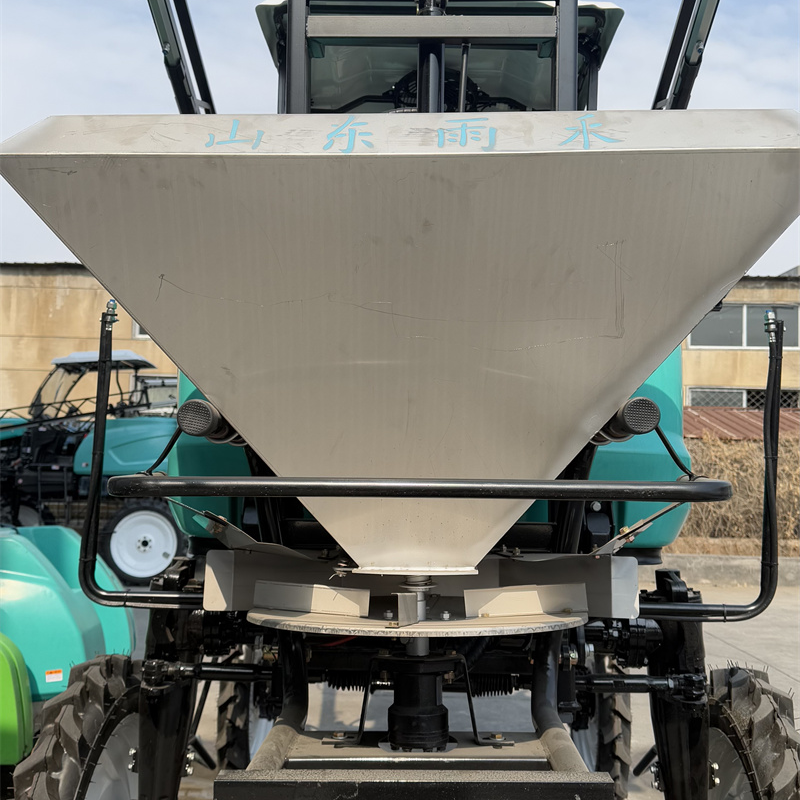
Pneumatic systems operate on entirely different mechanical principles. They move material using high-velocity forced air rather than centrifugal throwing. The internal workflow remains highly controlled from start to finish. Fertilizer flows directly from the main hopper into individual metering rollers. These precise rollers feed measured amounts of product into a powerful air manifold. The airstream carries the particles safely through long delivery tubes. Finally, the material strikes specially designed deflector plates located along the boom.
This enclosed delivery system fundamentally defeats the wind factor. The internal tubes deliver fertilizer directly to deflectors spaced evenly along the boom. Commercial boom lengths typically range from 40 to 90 feet wide. The deflectors force a highly controlled, vertical drop directly onto the soil. It acts much like a residential drop spreader but scaled for massive acreage. An advanced Agricultural Fertilizer Spreader maintains strict pattern integrity even in high winds.
Boundary control provides another major agronomic advantage. Traditional spinners struggle heavily to create clean, precise field edges. They inherently throw material in a wide, overlapping arc. Pneumatic booms allow operators to shut off individual boom sections instantly. You can cut application perfectly at the field edge. You can also stop flow immediately near sensitive environmental buffer zones. This capability prevents off-target application entirely. It guarantees strict adherence to environmental compliance standards.
The mechanical consistency eliminates the need for complex driving patterns. Operators of broadcast spreaders often drive in tight, overlapping circles to ensure coverage. Pneumatic booms provide true edge-to-edge uniformity in a single straight pass. You eliminate overlapping driving errors entirely. The vertical drop ensures every single inch of soil receives the exact same volume of product.
Variable Rate Technology (VRT) requires rapid, precise adjustments to application rates. Pneumatic systems excel at seamless VRT execution. Material meters continuously and directly into the high-velocity airstream. Rate changes happen almost instantaneously as the tractor moves. Hydraulic spinner setups often suffer from noticeable, frustrating lag times. By the time a traditional spinner adjusts, the tractor has already moved past the target zone. Pneumatic precision ensures the soil receives exactly what your prescription map dictates.
Handling complex fertilizer blends presents another historic agricultural challenge. Blended fertilizers contain elemental particles of differing weights and sizes. Spinners naturally separate these varied elements during airborne flight. Pneumatic systems completely prevent this airborne separation. The high-pressure airstream physically transports the blended mixture straight to the deflector plate. The chemical mixture remains perfectly intact until it hits the ground. Your crops receive the exact chemical ratio agronomists intended.
These machines offer exceptional material versatility for modern farming practices. You can apply lightweight cover crop seeds effortlessly. You can spread fine micro-nutrients, granular herbicides, or specialized soil amendments. These extremely light materials are notoriously difficult to broadcast widely. The wind simply carries them away. The forced-air system guarantees even, reliable coverage regardless of the product's bulk density.
| Material Type | Density Characteristics | Pneumatic System Advantage |
|---|---|---|
| Granular Urea | Medium/Consistent | Prevents shattering and dust generation during application. |
| Cover Crop Seeds | Very Light/Variable | Delivers seed directly to soil surface; prevents wind drift. |
| Blended NPK | Mixed Weights | Maintains blend integrity; eliminates ballistic segregation. |
| Micro-nutrients | Fine/Powder-like | Forced air prevents clumping and ensures micro-dose accuracy. |
Precision agricultural equipment requires a higher upfront financial commitment. You must weigh this initial purchase price directly against your current per-ton fertilizer costs. Commercial fertilizer prices remain historically high and heavily volatile. Wasted inputs drain farm profitability incredibly quickly. A pneumatic system typically reduces wasted inputs by a solid 5% to 10%. This massive reduction in material waste accelerates your break-even point. You recoup the extra investment rapidly through immediate material savings.
Build quality directly dictates machine longevity and lifetime value. You must evaluate the construction materials of the hopper and boom carefully. Many cheaper broadcast models use standard mild steel. Mild steel corrodes aggressively when exposed repeatedly to urea and agricultural salts. These basic units often last only three to seven years before failing structurally. Premium pneumatic systems utilize heavily reinforced 304 stainless steel components. An investment in stainless steel often yields a robust operational lifespan of 15 to 20 years.
Operational efficiency also drives your return on investment powerfully. High-capacity models cover vast acreage significantly faster than standard equipment. You maintain perfect application accuracy even at much higher ground speeds. This efficiency consolidates your necessary application passes across the field. Fewer passes mean significantly fewer hours spent on the tractor. You directly reduce both diesel fuel consumption and costly seasonal labor expenses.
You essentially buy time back during critical, narrow weather windows. Spring application windows shrink constantly due to unpredictable weather patterns. A high-capacity Agricultural Fertilizer Spreader allows you to finish thousand-acre blocks in a fraction of the time. You plant sooner, capture better moisture, and ultimately secure higher autumn yields.
You must clearly understand the complex realities of operating advanced pneumatic systems. We believe in setting transparent assumptions regarding sophisticated farm equipment. These machines have significantly more moving parts than simple gravity-fed models. They feature complex air blowers, intricate hydraulic manifolds, and extensive tubing networks. PTO-driven spinner models remain mechanically simpler overall. You trade mechanical simplicity for absolute agronomic perfection.
Rigorous maintenance routines are strictly non-negotiable for pneumatic models. You must implement daily cleaning protocols without fail. Fertilizer dust acts exactly like concrete glue in high-humidity environments. This fine dust easily cakes inside the air delivery tubes. A partially blocked tube creates severe, noticeable striping in the growing crop. Operators must thoroughly blow out the entire system after every single daily use.
Choosing the right chassis configuration requires strategic shortlisting logic. You generally choose between trailing units and dedicated truck-mounted chassis options.
Assess your tractor hydraulic flow: High-capacity trailed units demand massive hydraulic flow rates. You need adequate GPM (Gallons Per Minute) to run the large blower fans consistently.
Evaluate your field turning radius: Trailed models require substantial physical space to navigate headlands. They pull wider and longer than compact mounted units.
Consider truck-mounted rigs for extreme acreage: Dedicated truck chassis setups suit custom commercial applicators perfectly. They travel smoothly at high speeds between disconnected fields.
Check ISOBUS compatibility: Ensure your existing tractor monitors can communicate flawlessly with the spreader's digital controllers.
Proper storage also impacts operational readiness. You must store these advanced machines under roof cover. Constant exposure to rain degrades the specialized electronic rate controllers. Taking care of the implement ensures it delivers precision performance year after year.
A high-end pneumatic system is not universally necessary for every single small farm operation. However, it represents a strict strategic necessity for large-scale agricultural enterprises. You must prioritize input optimization and yield consistency above all else. The massive agronomic benefits easily outweigh the higher initial equipment costs.
Take definitive action today to improve your farm's nutrient management strategy. First, carefully audit your current historical fertilizer waste percentages. Next, review your existing tractor fleet's hydraulic capacities to ensure compatibility. Finally, consult directly with trusted agricultural equipment dealers to analyze specific boom configurations suited for your unique acreage.
A: Instead of throwing material in a wide arc using centrifugal force, pneumatic spreaders use a centralized blower. They push fertilizer through enclosed tubes along a wide boom. This ensures an even, wind-resistant vertical drop across the entire field swath, eliminating uneven ballistic scatter.
A: While they require precise initial mechanical setup, they are not difficult to manage daily. Modern pneumatic spreaders feature ISOBUS compatibility and advanced digital controllers. These systems largely automate the actual calibration process, ensuring exact flow rates dynamically based on your real-time ground speed.
A: No. Pneumatic systems absolutely require dry, free-flowing material. Wet or highly clumpy fertilizer can quickly clog the delicate metering rollers and the internal delivery tubes. Proper dry storage and a strong hopper agitator remain critical for smooth operation.
A: Generally, pneumatic spreaders are engineered specifically for large commercial operations or custom field applicators. Mid-sized farms may struggle to justify the ROI quickly. However, they become worthwhile if you grow extremely high-value crops, face strict environmental buffer zones, or battle aggressive daily wind conditions.


