

Views: 0 Author: Site Editor Publish Time: 2026-05-27 Origin: Site


Transitioning from manual spreading to mechanized application demands careful thought. It is rarely just about saving labor time. This upgrade represents a critical agronomic decision for your entire farm operation. Uneven manual application causes localized nutrient lock-up in the soil profile. It quickly leads to severe fertilizer burn and compromised crop yields. Outdated manual practices simply hold back true agricultural productivity. Relying on hand-crank tools for large plots invites poor material distribution. This guide evaluates objective efficiency gains and yield impacts directly. We compare basic hand-held manual methods against advanced commercial-grade machinery. We analyze mechanical precision, operational scalability, and equipment longevity. You will learn how to right-size your application protocols effectively. This targeted approach helps you maximize crop health. By understanding key technical variables, you can eliminate wasteful product overlap. Let us explore the engineering behind proper nutrient distribution.
Acreage Thresholds: Manual spreaders lose operational viability past the 5,000 sq. ft. mark due to hopper capacity limits and refill downtime.
The "75% Rule": Agricultural broadcast spreaders require overlapping passes at 75% of their maximum throw width to prevent "fertilizer striping" and ensure uniform crop emergence.
Speed-to-Error Ratio: In manual and drop-style spreading, a 10% fluctuation in walking speed (ideally baseline at 2.75 to 3 mph) can cause a 5–7% error in application rate, a variable eliminated by PTO or hydraulic-driven systems.
Agronomic Impact: Mechanized spreaders support banded and variable rate technology (VRT) applications, directly improving nitrogen utilization and reducing runoff compared to manual broadcasting.
Manual hand-crank spreaders serve specific, highly limited purposes. They work optimally strictly for micro-applications across small properties. We define micro-applications as areas under 2,000 to 5,000 square feet. These small devices help you navigate highly irregular boundary lines easily. They let you avoid delicate obstacles where heavy machinery cannot physically fit. For suburban gardens or tight orchards, they remain useful tools.
However, manual application carries severe hidden burdens for professional users. You must watch out for these operational bottlenecks.
Refill Inefficiency: Small hopper capacities demand constant refilling operations. You spend significantly more time walking back to your material supply. This exponentially increases raw labor hours on larger agricultural plots. The physical toll on workers adds up rapidly over a single afternoon.
Human Variable Error: Operator fatigue inevitably sets in during manual tasks. It leads directly to inconsistent walking speeds and irregular crank rates. Uneven soil coverage happens quickly under these physical conditions. You will see this as visible "stripes" of over-fertilized and under-fertilized vegetation. These stripes signal severe nutrient mismanagement.
Limited Material Compatibility: Manual spreaders struggle immensely under heavy or wet loads. Coarse materials like damp compost, gypsum, or heavy lime clump together. They require continuous mechanical agitation to prevent bridging. Bridging occurs when material forms an arch over the feed gate. This blocks all downward flow instantly.
A common mistake is pushing manual equipment past its intended acreage limits. You might save on upfront machinery purchases. However, you will lose significant yield due to uneven nitrogen distribution.
Upgrading to an Agricultural Fertilizer Spreader shifts your operational focus entirely. You move past mere labor reduction discussions. You begin prioritizing maximum crop yield and soil vitality. Consistent material distribution prevents dangerous nutrient gaps. It stops uneven patches from stunting early plant growth.
Mechanized units give operators multiple highly precise application styles:
Broadcast Application: This method allows rapid, wide-swath coverage across open fields. It works beautifully for flat, unencumbered acreage. The mechanized spinner plates distribute heavy granules evenly across a massive radius. This saves days of grueling field labor while protecting soil integrity.
Banded or Trenching Application: Advanced mechanized units drop fertilizer directly near the root zone. This targeted approach significantly lowers dangerous nutrient runoff. It improves root absorption rates rapidly during early growth stages. Manual scatter methods make this precise placement utterly impossible.
Volume matters greatly for continuous, uninterrupted field operations. Tractor-mounted hoppers perfectly match your specific field acreage. Pull-type models hold massive material payloads securely. Operators complete entire land sections without stopping to refill. This uninterrupted flow maintains a continuous nutrient baseline. A steady baseline guarantees uniform crop emergence across the entire farm.
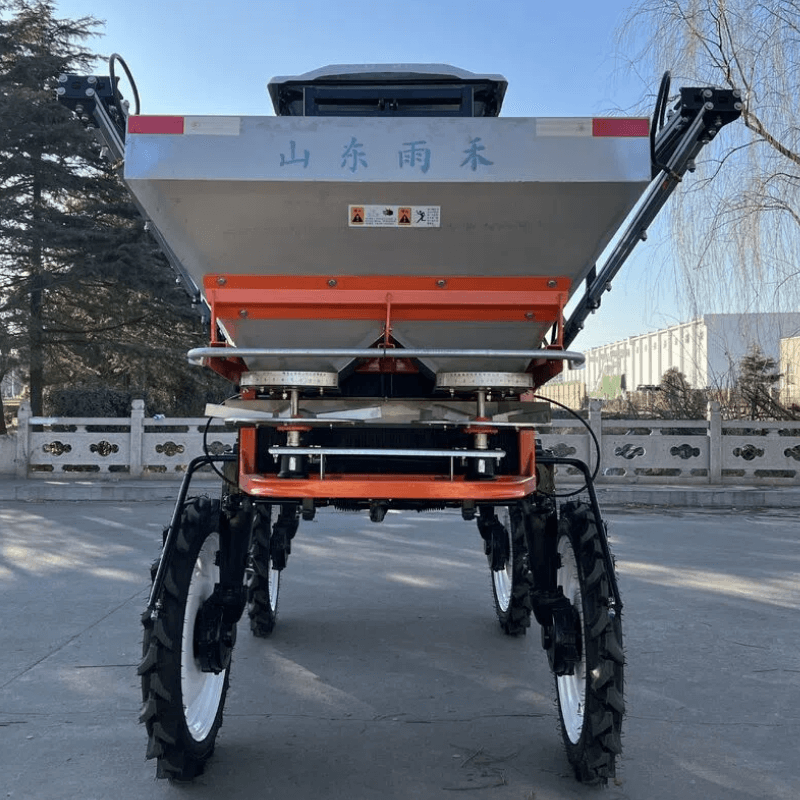
Choosing the correct equipment requires matching specialized attachments to your terrain. You must also select a drive mechanism for adequate field precision. A mismatched machine wastes both valuable time and expensive fertilizer.
Here is a detailed breakdown of your attachment and chassis options:
| Attachment Type | Ideal Agricultural Use Case | Primary Operational Limitations |
|---|---|---|
| 3-Point Hitch Mounted | Navigating muddy terrain, tight orchards, and short turnarounds. | Payload is limited entirely by the tractor's rear lift capacity. |
| Pull-Type (Tow-Behind) | Large-scale commercial farming needing massive hopper material capacity. | Lacks turning agility on steep slopes or highly uneven field terrain. |
| Truck-Mounted Chassis | Extensive commercial custom-application operations across multiple dispersed farms. | Requires significant facility infrastructure and wider field access roads. |
Drive mechanisms serve as the true precision engine of your spreader. They dictate how accurately you apply materials across varying landscapes.
Ground-Driven / Push Systems: These traditional systems remain structurally simple and highly cost-effective. However, the exact application rate stays directly tied to your tractor's travel speed. If you slow down for a turn, the spread rate drops.
PTO (Power Take-Off) Drive: PTO offers reliable, standardized power transfer from the tractor. It provides a highly consistent spinner plate rotation speed. Terrain variations or deep mud do not affect the output rotation.
Hydraulic Drive Systems: We consider hydraulic mechanisms the gold standard for modern precision agriculture. They integrate seamlessly into digital GPS and ISO control systems. You can enable Variable Rate Technology (VRT) easily. The spreader dynamically adjusts its output based on detailed digital soil mapping.
You must master the effective swath concept for proper field distribution. Many novice operators make a severe implementation failure here. They treat the maximum physical throw distance as the usable field width. Mechanized broadcast spreaders generally have an "effective swath." This working swath covers about 75% of their total physical throw.
For example, a spreader throwing granules 40 feet wide only provides uniform coverage for 30 feet. Precision requires calibrating your field overlap paths carefully. You must overlap that outer 25% margin on every pass. This prevents edge-tapering and eliminates nutrient stripping entirely. Always map your driving paths before engaging the PTO.
Managing bulk material flow ensures consistent application rates. Mechanized units utilize heavy-duty internal agitators. The agitator acts as a highly critical mechanical component. It constantly stirs the material inside the main hopper. It prevents granular fertilizer, damp lime, or fine seed from clumping. Clumps easily block the bottom feed gate entirely.
Different materials demand vastly different aperture settings. Heavy agricultural lime flows much differently than light grass seeds. Failure to perform empty-load flow testing guarantees disastrous application errors. Always run a measured calibration test before entering the actual field.
Here are brief best practices for reliable calibration:
Set the flow gate to a neutral mid-point based on the manufacturer's chart.
Load a small, precisely weighed amount of your intended material.
Drive a measured distance at your intended operational speed.
Weigh the remaining material to calculate the exact dispersal rate.
Adjust the flow gate aperture accordingly.
Material construction directly dictates your new machinery's overall lifespan. Agricultural fertilizer contains highly corrosive chemical compounds. Nitrogen and urea eat raw steel rapidly. Mid-sized units often use high-density polyethylene (HDPE) hoppers. HDPE offers fantastic rust-proof, lightweight durability for everyday agricultural tasks.
Commercial agricultural demands are much harsher on moving equipment. They often necessitate heavy 304 Stainless Steel components. Stainless steel withstands massive material loads seamlessly. It fights off aggressive chemical wear over multiple decades. When you choose a chassis, prioritize corrosion resistance over initial aesthetics.
Follow these Standard Operating Procedures (SOPs) for maximum equipment longevity:
Immediate Cleanout: Execute a thorough cleanout post-application. Wash down the equipment meticulously to halt aggressive surface corrosion. Never let fertilizer sit in the hopper overnight. Moisture from the air will turn it into a concrete-like block.
Routine Lubrication: Grease the PTO drive shaft frequently. Lubricate the main spinner plate bearings and flow-gate metal linkages regularly. Dry bearings fail spectacularly under heavy field loads.
Operators face common troubleshooting scenarios in the field. Let us review basic diagnostic protocols.
Uneven Spreading Patterns: Worn spinner fins usually cause this frustrating issue. Uncentered flow gates also push falling material to one specific side. Inspect the drop zone geometry first. Replace bent fins immediately to restore an even spread.
Gate Mechanism Jamming: Hardened, crusty fertilizer causes most gate jams. Linkage failures from a severe lack of lubrication also freeze the sliding gate. Always clear old debris before loading fresh material into the hopper.
Let us summarize our comprehensive equipment evaluation. Manual spreading serves primarily as a localized garden tool. It is certainly not a scalable, professional agricultural strategy. Transitioning to a mechanized machine makes perfect agronomic sense. You justify this operational shift when labor limits, material waste, or inconsistent crop yields appear. Mechanization solves these fundamental farm growth barriers immediately.
Evaluate your specific operational needs closely today. Measure your primary field acreage totals accurately. Identify your primary material types, whether they are granular fertilizer, coarse lime, or seed. Assess your existing tractor capabilities regarding available PTO or Hydraulic output. Use this gathered data to shortlist the appropriate 3-point or pull-type unit. Prioritize robust models offering easy-clean design features. Always demand heavy-duty agitators for consistent, trouble-free material flow. Taking these steps ensures your fields receive the precise nourishment they require.
A: For residential or light landscaping, push units become necessary past 5,000 sq. ft. For true agricultural use, 3-point tractor-mounted spreaders should be implemented for anything exceeding 1 to 2 acres. This mechanical upgrade maintains essential agronomic consistency across larger plots.
A: This indicates a clear calibration or operational error. It usually means the operator is not overlapping passes correctly. They are likely failing to utilize the 75% effective swath rule. A fluctuating PTO speed or inconsistent walking speed also causes noticeable striping.
A: Yes, it can handle multiple materials efficiently. The unit must be equipped with a heavy-duty agitator to prevent bridging. The operator must also recalibrate the flow gate and spinner speed. You must adjust these vital settings carefully for the specific density of the new material.


