

Views: 0 Author: Site Editor Publish Time: 2026-07-04 Origin: Site


Modern agriculture faces a constant, demanding operational challenge. You must apply crop protection chemicals and fertilizers with exact precision across massive acreage. You cannot afford to waste expensive materials. You also cannot risk violating strict environmental drift regulations. Enter the agricultural boom sprayer. It stands as the industry-standard equipment for uniform, wide-swath liquid application. These machines transform complex chemical applications into a highly controlled, repeatable process.
Choosing, configuring, and operating the right equipment dictates farm profitability. It ensures maximum yield protection while maintaining absolute regulatory compliance. This comprehensive guide breaks down the core applications, evaluates equipment alternatives, and explores critical purchasing criteria. You will learn how to match the right spraying technology to your specific terrain and crop requirements.
Core Function: Boom sprayers deliver uniform distribution of herbicides, pesticides, and liquid fertilizers over large areas, minimizing chemical waste.
Operational ROI: Precision nozzles and drift control technologies reduce input costs and ensure environmental compliance.
Equipment Alternatives: While boom sprayers excel in open, flat acreage, boomless sprayers are better suited for rugged, obstacle-heavy terrain.
Selection Criteria: Buying decisions must hinge on tank capacity, mounting style (3-point hitch, trailed, self-propelled), and nozzle technology matched to the farm's scale and crop type.
Maintenance Reality: Consistent calibration is non-negotiable for maintaining application accuracy and preventing costly over-spraying.
Crops demand exact chemical dosages to thrive. Under-apply chemicals, and you risk breeding pest or weed resistance. Over-apply them, and you trigger severe crop burn and significant financial loss. Precision application solves this fundamental business problem. A high-quality Boom Sprayer guarantees that every acre receives the exact necessary dosage.
Uniform foliar coverage is the ultimate goal when managing weeds and pests. Boom sprayers achieve this by using evenly spaced nozzles along a horizontal frame. They create overlapping spray patterns. This overlap guarantees full coverage without leaving untreated gaps.
Contact herbicides require extremely fine droplets to coat leaf surfaces thoroughly. Systemic pesticides often perform better using slightly larger droplets. Operators can easily switch nozzles on a boom to match these specific chemical requirements. Boom height adjustment plays an equally vital role here. You must match the boom height to the specific crop growth stage. Setting the boom approximately 20 inches above the target canopy typically provides the ideal spray angle and overlap.
Always match the nozzle type to the chemical manufacturer's droplet size recommendation.
Maintain a consistent travel speed to ensure uniform application rates.
Adjust boom height actively as you move between fields of different maturity levels.
Modern farming relies heavily on precise nutrient timing. Boom sprayers excel at distributing liquid fertilizers for both top-dressing and foliar feeding. Soil-applied fertilizers require high volumes of liquid to reach the root zone. Foliar feeds require a fine mist to absorb directly through the plant leaves.
The primary advantage here is the wide-swath application capability. Nutrient application windows are incredibly time-sensitive. A sudden rainstorm or a fast-advancing growth stage can close this window rapidly. A wide boom allows operators to cover hundreds of acres in a single day. This speed ensures crops receive critical nutrients exactly when they need them most.
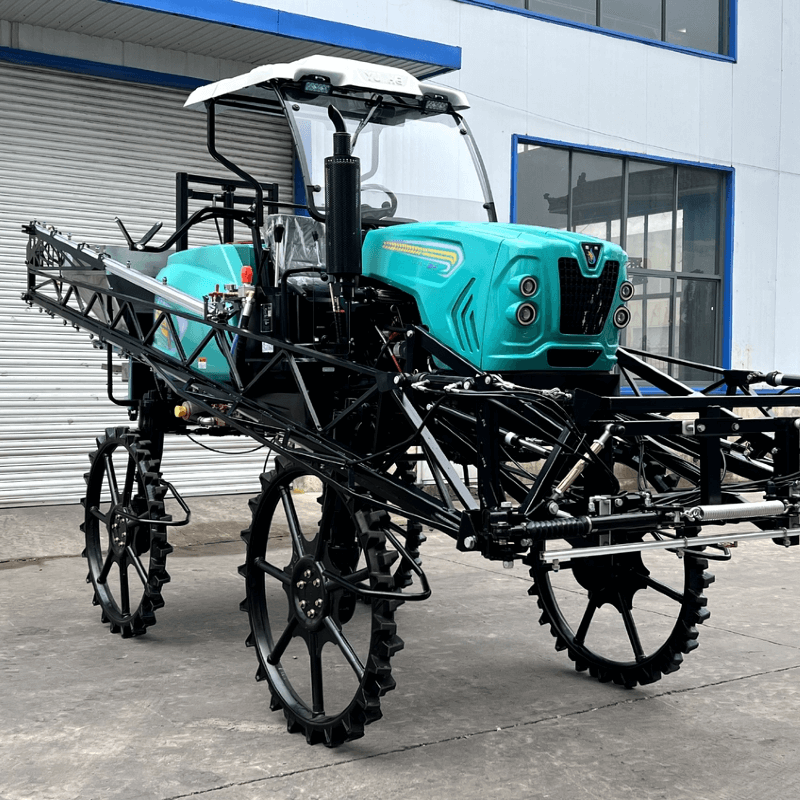
Selecting between boom and boomless technology requires a direct, objective comparison. Buyers must evaluate their unique topography and coverage needs to shortlist the right equipment.
The following chart compares the two technologies across critical operational dimensions:
| Evaluation Dimension | Agricultural Boom Sprayer | Boomless Sprayer |
|---|---|---|
| Coverage Uniformity | Extremely High | Moderate |
| Drift Vulnerability | Low (with proper nozzles) | High |
| Terrain Suitability | Open, flat, or gently rolling | Rugged, uneven, obstacle-heavy |
| Precision Control | High (Section control available) | Low (Broadcast only) |
These units represent the gold standard for precision agriculture. They thrive in large, flat, or gently rolling fields. Row crops demand strict drift control and pinpoint accuracy. An agricultural boom sprayer delivers exactly this level of control.
However, they possess notable limitations. The wide, physical arms remain highly vulnerable to structural damage. If you operate in fields littered with hidden stumps, low-hanging trees, or tight fences, the boom risks severe impact damage. Extreme uneven terrain can also cause the boom tips to strike the ground, breaking nozzles and bending frames.
Boomless models utilize central cluster nozzles to project fluids outward over a wide distance. They eliminate the physical arms entirely. This design makes them ideal for pastures, dense forestry, ditches, and highly irregular terrain. Whenever a physical boom would snag or break, a boomless system steps in.
You must accept specific trade-offs when choosing this route. Coverage lacks the strict uniformity of an agricultural boom sprayer. The projected droplets are highly susceptible to wind drift. Precision plummets at the edges of the spray swath. They serve well for general weed suppression but fail when exact chemical dosing is required.
Equipment features only matter if they drive positive financial outcomes and mitigate farm risk. You should tie every mechanical component of a boom sprayer directly to its operational return on investment.
Chemical inputs often represent the largest variable expense on any farm. Overlapping spray patterns from evenly spaced nozzles prevent two costly errors: "misses" and "double-dosing." A miss allows weeds to choke out crops. Double-dosing burns the crop and wastes expensive chemicals.
Modern units utilize advanced section control technology. This system automatically shuts off specific parts of the boom when crossing over previously sprayed areas. It shines particularly on point rows or irregular headlands. By eliminating overlap automatically, section control reduces overall chemical usage by up to 15 percent annually. This translates directly into substantial financial savings.
Running nozzles past their rated lifespan, causing worn orifices and severe over-application.
Ignoring boom bounce, which disrupts the overlapping spray pattern and creates uneven dosing.
Failing to calibrate pressure gauges before the start of the spraying season.
Chemical drift presents a massive liability. Allowing herbicides to drift onto neighboring properties or sensitive waterways invites severe regulatory fines and lawsuits. Protecting your farm from these liabilities is paramount.
Modern boom sprayers mitigate drift through integrated engineering. Air-induction nozzles mix air into the fluid stream. This creates larger, heavier droplets less prone to wind disruption. Precise pressure regulation ensures the pump does not force fluid through nozzles too forcefully, which would shatter droplets into drift-prone mist. Furthermore, operators can install low-drift shields over the boom arms. These physical barriers block wind sheer, ensuring the chemicals reach the ground safely.
Procuring the right equipment requires analyzing several evaluation dimensions. You must align the machinery with your specific operational scale and mechanical capabilities.
The mounting style dictates maneuverability, capacity, and the required towing power. Evaluate the three primary categories:
Tractor-Mounted (3-Point): These units connect directly to the tractor's three-point hitch. They suit small to medium farms perfectly. They are highly maneuverable in tight spaces. However, their tank capacity remains strictly limited by the tractor's rear lift capacity.
Trailed (Pull-Type): These models attach via a drawbar and run on their own axles. They prove ideal for larger acreage. They support massive tank capacities ranging from 500 to over 1,500 gallons. You will need a heavier, higher-horsepower tractor to tow them effectively across muddy terrain.
Self-Propelled: This represents the ultimate enterprise-level solution. These machines feature their own engines, cabs, and drivetrains. They offer maximum ground clearance, allowing late-season spraying in tall crops. They deliver the highest application speeds but require the highest capital expenditure.
Dig deeper into the internal components to ensure long-term reliability. Pump selection proves critical. Diaphragm pumps handle abrasive and harsh chemicals beautifully. They generate high pressure effectively. Centrifugal pumps, conversely, move massive volumes of fluid at lower pressures. Match your pump to the fluid viscosity and pressure requirements of your typical applications.
Next, evaluate boom construction materials. Steel booms offer incredible durability and structural strength. They withstand heavy impacts but add significant weight to the machine. Aluminum or fiberglass booms provide a lightweight, corrosion-resistant alternative. They reduce soil compaction and resist chemical rust, though they require a higher initial investment.
Owning premium equipment constitutes only half the battle. Proper implementation and maintenance dictate long-term success. Overlooking these realities guarantees poor field performance.
Nozzles wear out. Pumping abrasive liquids through tiny plastic or metal orifices inevitably alters their flow rates over time. An uncalibrated sprayer will systematically apply the wrong amount of chemical. You must routinely calibrate the system to ensure your target gallons-per-acre (GPA) remains absolutely accurate.
We strongly advocate for rapid, standardized calibration methods. The "One-Minute Method" serves as a highly reliable industry standard. Here are the core steps:
Measure the distance between your nozzles in inches.
Determine the required calibration travel distance based on standard charts matching your nozzle spacing.
Drive that exact distance in the field at your normal spraying speed, timing how many seconds it takes.
Park the tractor, turn on the sprayer at normal operating pressure, and catch the fluid from one nozzle for that exact number of seconds.
Measure the caught fluid in ounces. This number directly equals your applied gallons per acre.
Preventative maintenance eliminates costly in-field downtime. Certain components fail predictably. You must monitor clogged strainers, worn nozzles, and degraded rubber hoses continuously. Clean all line strainers daily during the active season. Replace nozzles whenever calibration shows a flow rate deviation exceeding 10 percent.
Winterization remains crucial. Freezing temperatures will shatter pumps and crack manifolds if water remains inside. Always flush the entire plumbing system post-application to remove chemical residue. Before winter arrives, circulate RV antifreeze through the pump, boom lines, and nozzles. This baseline maintenance protects your investment year after year.
An agricultural boom sprayer serves as a vital investment in input efficiency and crop safety. It functions as much more than a simple chemical delivery tool. It protects your crops, preserves expensive chemicals, and ensures you remain compliant with strict environmental laws.
When shortlisting equipment, weigh your specific terrain needs carefully. Determine whether a physical boom or a boomless model suits your fields. Evaluate your acreage scale to select the right tank size and mounting style. Finally, scrutinize the pump and nozzle technology to match your precision requirements.
Take proactive steps today. Consult with an agricultural equipment specialist to discuss your specific operational needs. Request a detailed quote, or view a comprehensive product catalog to match a high-performance sprayer directly to your tractor and acreage profile.
A: Boom width varies dramatically based on operational scale. Small ATV or UTV setups typically range from 10 to 15 feet wide. Tractor-mounted models often span 30 to 60 feet. Enterprise self-propelled models frequently feature massive booms stretching 120 feet or more to maximize coverage speed.
A: Your driving speed depends entirely on your initial calibration, nozzle type, and field terrain. However, operators typically maintain speeds between 4 and 8 mph. Driving within this range maintains consistent pressure stability and prevents excessive boom bounce, which causes uneven chemical distribution.
A: You should replace nozzles annually or after spraying a predetermined number of acres. The definitive replacement indicator is a 10% deviation in flow rate during routine calibration checks. Operating with worn nozzles inevitably leads to expensive chemical over-application and potential crop damage.


