

Views: 0 Author: Site Editor Publish Time: 2026-07-06 Origin: Site


Selecting the right agricultural spraying equipment represents a critical capital decision. It directly impacts chemical efficacy, labor efficiency, and regulatory compliance. You face a major dilemma when upgrading your fleet. The choice between a traditional Boom Sprayer and a mist sprayer requires balancing application precision against terrain flexibility. Both options offer distinct mechanical advantages but carry unique operational limitations. Many operators struggle to determine which system provides necessary canopy penetration without violating strict drift regulations. Choosing incorrectly leads to wasted chemicals, poor pest control, and potential legal liabilities. This guide breaks down how these machines work, their environmental risks, and their ideal use cases. You will explore the mechanical differences separating hydraulic pressure systems from air-blast technology. Finally, you will learn how to evaluate which configuration best aligns with your acreage, target foliage, and local compliance standards.
Boom Sprayers deliver targeted, downward chemical application ideal for flat terrain, row crops, and strict drift control.
Mist Sprayers utilize fan-forced air to propel fine droplets over wide areas, excelling in dense brush, orchards, and uneven terrain where physical booms cannot reach.
The primary evaluation criteria for shortlisting include terrain topography, target foliage density, wind constraints, and local environmental compliance regulations.
Understanding mechanical differences helps you choose the right tool for your farm. Each system approaches liquid distribution differently. They use different physical forces to deliver active ingredients.
A standard field boom sprayer utilizes horizontal folding arms. Manufacturers often build these arms from durable metal or flexible fiberglass. The arms feature multiple downward-facing nozzles spaced evenly apart. The system relies entirely on direct hydraulic pump pressure. This pressure forces liquid downward in uniform, overlapping patterns. Operators must maintain a consistent distance from the ground or the crop canopy. This distance ensures optimal spray pattern overlap. If the arms ride too high, wind catches the droplets. If they ride too low, the application becomes heavily concentrated in narrow strips. Standard systems use flat-fan or air-induction nozzles. These nozzles adhere strictly to ASABE (American Society of Agricultural and Biological Engineers) droplet size standards.
A mist sprayer operates on completely different aerodynamic principles. It utilizes a high-velocity fan. This fan typically runs off the tractor's Power Take-Off (PTO) shaft. The fan pushes massive volumes of air through a directional volute or chute. As the pump delivers liquid to the volute nozzles, the intense air stream atomizes the fluid. It shears the liquid into a very fine mist. The machine then propels these tiny droplets horizontally or vertically. It uses the air stream rather than relying solely on hydraulic pressure and gravity. This design eliminates the need for extended physical arms. The machine operates entirely from a compact base unit mounted to the hitch.
| Component Feature | Boom Equipment | Mist Equipment |
|---|---|---|
| Delivery Force | Hydraulic pump pressure and gravity | High-velocity forced air stream |
| Physical Span | Wide horizontal folding arms (20-120 ft) | Compact base unit; no extended arms |
| Droplet Size | Medium to ultra-coarse (200-600+ microns) | Fine to very fine (50-150 microns) |
| Application Direction | Strictly downward facing | Horizontal, vertical, or omnidirectional |
The core difference between these two systems involves precision versus reach. You must decide if you need pinpoint accuracy or massive volumetric coverage. Each method handles chemical distribution uniquely.
Predictable Coverage: Hydraulic arms provide highly predictable coverage per square foot. The downward force ensures chemicals land exactly where you want them.
Reduced Waste: This targeted approach minimizes chemical waste. It applies active ingredients directly to the specific treatment zone.
Soil Application: These units remain ideal for soil-applied herbicides. They lay down a consistent chemical barrier over flat dirt.
Uniform Treatment: They excel at uniform field crop treatments. Every plant receives an identical dosage rate.
Leaf Turning: The turbulent air stream from a blower actively turns leaves. This turbulence allows chemicals to coat both the top and underside of the foliage.
Distance Reach: Powerful blowers can reach distances of 50 to 150 feet. The actual range depends heavily on fan size and ambient wind conditions.
Pest Control: Coating the underside of leaves proves crucial for insecticide application. Insects naturally hide underneath foliage to escape predators and sun.
Tank Efficiency: Atomizers use significantly less water as a carrier fluid. You apply lower Gallons Per Acre (GPA). This drastically increases your tank efficiency and reduces refill trips.
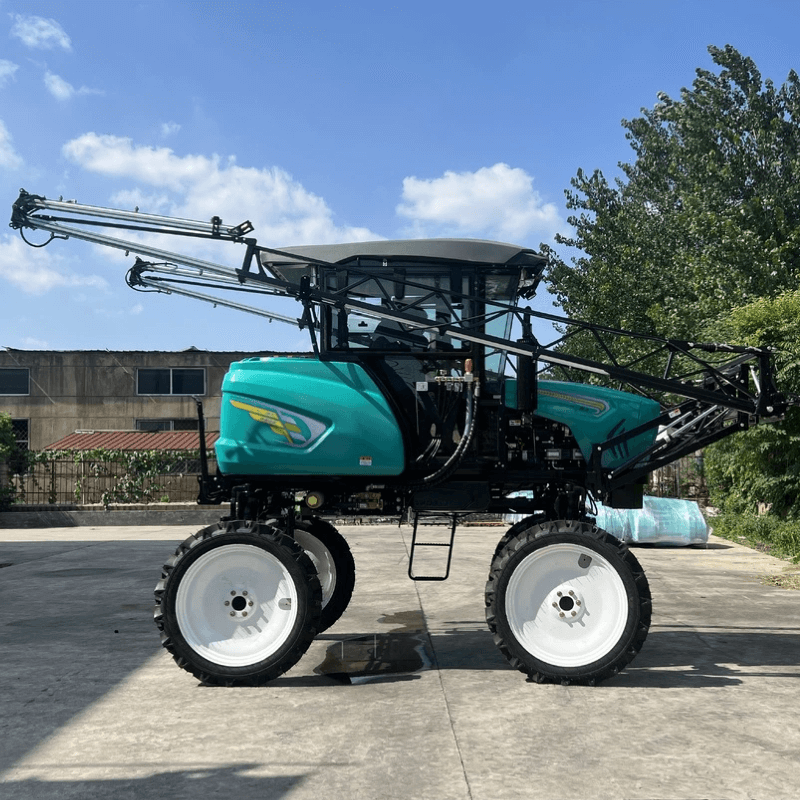
Your local geography dictates equipment suitability. You cannot force a machine to operate outside its physical limitations. Terrain matching remains the most important step before acquiring new equipment.
Optimal Terrain: You should use this equipment on flat, cleared agricultural fields. It also excels on large pastures and professionally maintained turf.
Primary Targets: Use it for row crops like corn and soybeans. It effectively manages low-lying weeds and handles precise liquid fertilizer applications.
Limitation: Physical booms risk striking the ground. They easily hit rocks, stumps, or fences on highly uneven or wooded terrain.
Optimal Terrain: Choose air-blast systems for rough, uneven ground. They perform beautifully along deep ditches, steep ravines, and fenced boundaries.
Primary Targets: Deploy them in orchards, vineyards, dense brush, and timber. They also provide excellent livestock insect control in open feedlots.
Limitation: They remain entirely ineffective for precise, low-to-the-ground soil treatments. The swirling air scatters pre-emergent herbicides haphazardly across flat acreage.
Many operators mistakenly deploy air-blast units for flat pasture weed control. The fine droplets evaporate quickly or drift away before hitting low-lying thistles. Always match your equipment to the target foliage height. Rely on hydraulic arms for ground-level targets. Rely on air blowers for vertical canopies.
Chemical drift presents a massive liability for modern farm operations. Regulatory agencies constantly monitor off-target chemical movement. You must understand how your equipment handles wind factors.
Hydraulic systems offer superior drift control. They produce larger, heavier droplet sizes. These heavier droplets fall rapidly to the ground. The nozzles sit very close to the target canopy. This proximity limits the time droplets spend falling through the air. It makes it significantly easier to comply with strict EPA buffer zone regulations. You can operate safely near sensitive crops, organic farms, waterways, or residential areas. Operators can easily integrate drift-reduction nozzles. You can also install physical plastic shrouds over the arms to block wind interference.
Air-blast systems carry a high inherent risk of chemical drift. Fine atomization creates microscopic droplets. Horizontal air propulsion pushes these tiny particles high into the atmosphere. Application remains heavily constrained by daily weather. You absolutely cannot operate these machines in moderate-to-high wind conditions. The wind easily overpowers the fan stream and carries chemicals miles away. Operating these units requires rigorous operator training. You must calculate wind vectors accurately. You must maintain strict legal buffer zones downwind from your application path.
Always monitor ambient wind speed using a handheld anemometer. Never spray when wind speeds exceed manufacturer recommendations. Keep detailed spray logs noting wind direction, humidity, and temperature. High temperatures and low humidity accelerate droplet evaporation. This evaporation creates smaller, drift-prone particles mid-air.
Different mechanical designs require entirely different maintenance routines. You must prepare your shop for the specific upkeep demands of your chosen equipment. Neglecting these tasks leads to catastrophic mid-season failures.
Extended physical arms require constant mechanical oversight. You must perform regular inspections of folding hinges and breakaway mechanisms. Breakaway joints prevent permanent damage when the arm hits an obstacle. The multiple nozzle bodies require frequent cleaning. Sand and debris easily clog fine nozzle tips. The equipment remains highly prone to physical damage. Striking a rock, tree, or uneven ground bends the metal frame instantly. Winterizing these machines involves complex procedures. You must blow compressed air through extensive plumbing lines. Trapped water freezes and cracks expensive manifold blocks over the winter.
Air-blast units feature far fewer fragile external parts. You do not worry about folding arms breaking on fence posts. However, the internal mechanics demand strict maintenance. You must grease fan bearings regularly. You must inspect drive belts for dry rot and tension loss. The primary pump requires clean oil and fresh seals. Setup demands proper tractor matching. The large blower requires substantial and consistent PTO horsepower. If your tractor cannot maintain the required PTO RPMs, the air stream collapses. A weak air stream fails to atomize the liquid properly, resulting in poor canopy penetration.
Evaluating your farm's unique profile simplifies the purchasing process. You must align equipment capabilities with your daily operational realities. Use this framework to narrow down your choices.
Your primary goal involves weed control or fertilization on flat, unobstructed land. You operate in regions with strict drift regulations. You farm immediately adjacent to sensitive neighboring crops or housing developments. You require exact, measurable chemical application per acre to meet agronomic formulas.
You treat tall vertical canopies like mature trees and orchards. You manage dense brush where physical tractor entry remains impossible. Your terrain proves too rugged, steep, or obstacle-ridden for a wide horizontal metal frame. You need to cover a large area quickly. You want to significantly reduce the amount of carrier water hauled to the field.
| Decision Criteria | Advantage: Hydraulic Arms | Advantage: Air-Blast System |
|---|---|---|
| Terrain Type | Flat, cleared, highly maintained | Steep, rough, wooded, ditches |
| Target Foliage | Low weeds, bare soil, row crops | Tall trees, dense brush, orchards |
| Wind Tolerance | Can handle light to moderate breezes | Requires dead calm to very light wind |
| Drift Liability | Low risk (easy to contain) | High risk (requires large buffer zones) |
The choice between these two agricultural tools rarely comes down to which machine performs objectively better. The decision rests entirely on which physical limitations your operation can tolerate. Hydraulic arms offer unmatched precision and environmental safety. However, they restrict your mobility in rugged areas. Air-blast systems provide incredible reach and canopy penetration. Yet, they demand strict weather monitoring and carry significant drift liabilities. Audit your primary terrain type carefully. Map your most frequent chemical application targets. Finally, consult with an equipment specialist to calculate the exact PTO horsepower and tank capacity required for your chosen system.
A: Yes, but it is highly inefficient and risky due to drift compared to a dedicated field equipment setup. The swirling air scatters herbicides unevenly. This leaves major gaps in your weed barrier. It also increases the risk of damaging neighboring crops.
A: A boomless sprayer uses specialized nozzles to shoot a concentrated liquid stream horizontally. It relies entirely on internal hydraulic pump pressure. A mist sprayer uses a mechanical PTO-driven fan to blow fine droplets through a targeted air stream.
A: They use significantly less carrier water due to fine atomization. However, the active chemical rate per acre remains dictated by the manufacturer's label. You simply mix the same amount of active chemical into a smaller volume of water.
A: Generally, anything above 5-7 mph significantly increases your drift risk. The wind overpowers the machine's air stream. Conversely, downward-facing hydraulic systems can sometimes operate safely in slightly higher winds if you install approved drift-reduction nozzles.


